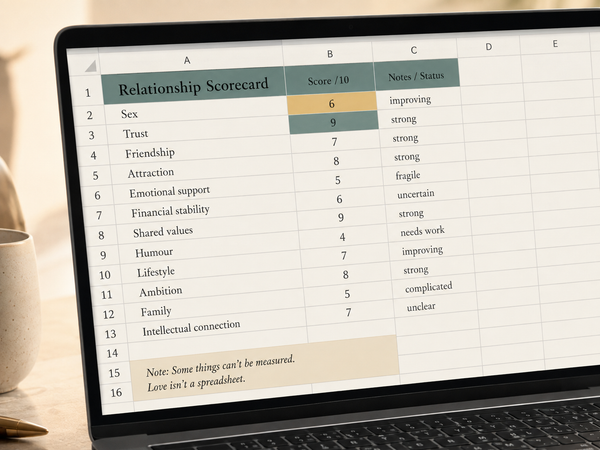
Are We Becoming Too Good at Being Single?
We say we want to meet someone. But after years of building a life that works perfectly well alone, how much are we really prepared to rearrange for love?

There is a particular moment in modern single life that can be difficult to admit.
You would like to meet someone. You miss intimacy, companionship, sex, the feeling of being known by another person. You can imagine falling in love again and, on certain evenings, you would very much like someone to be there.
Then someone actually appears.
And suddenly they want to spend Saturday together.
The Saturday you had already planned.
They leave things in your bathroom. They have opinions about where to eat. They sleep at a temperature that appears incompatible with human survival. They ask what you are doing next weekend when, until recently, next weekend belonged entirely to you.
After years of longing for a relationship, the arrival of one can produce a strangely contradictory reaction: this is wonderful — but what is happening to my life?
Perhaps one of the less discussed challenges of modern dating is not that we have forgotten how to find a partner. It is that many of us have become exceptionally good at living without one.
Single life is no longer necessarily a waiting room
For generations, adulthood was organised around partnership. Leaving home, marrying, building a household and having children were not simply personal choices; they were the architecture of a socially recognisable life.
That architecture has changed dramatically.
Across Europe, living alone has become increasingly common. In 2025, single adults without children represented 37.5% of all EU households, and their number had risen by more than 19% in less than a decade. Living alone is not the same thing as being romantically single, of course, but the figures illustrate a profound shift in the way adult life is organised.
A single person today can build a complete life without waiting for a partner to unlock adulthood. They can buy a home, travel, have children, develop deep friendships, change countries, create financial security and build routines that are entirely their own.
This is particularly significant for women. Economic independence and changing social expectations mean that a relationship is far less likely to be a practical necessity than it was for previous generations. Partnership increasingly has to justify itself emotionally.
It cannot simply provide a socially acceptable life.
The life may already be there.
Independence is surprisingly comfortable
There are obvious disadvantages to being single. Loneliness exists. So does the absence of physical affection, shared responsibility and the intimacy of having another person witness the ordinary details of your life.
But singlehood offers pleasures that couples sometimes remember rather nostalgically.
Your time belongs to you. Your home operates according to your preferences. There is no negotiation over holidays, family obligations, spending, social calendars, bedtimes or whether a perfectly good Sunday must really involve visiting someone else's relatives.
You can eat at 10 p.m., spend three hours in a museum, accept a job in another city or decide on Thursday that you are going to Lisbon on Friday without convening a bilateral summit.
Over time, these small freedoms stop feeling like freedoms. They simply become life.
Research into singlehood increasingly reflects this complexity. Psychologists have moved away from treating single people as one homogeneous group of individuals waiting to become coupled. Satisfaction with single life varies considerably, and factors such as autonomy, social support, the desire for a relationship and whether singlehood feels chosen all influence well-being.
This seems intuitively important. There is an enormous difference between being alone when you desperately do not want to be and building a life alone that you genuinely enjoy.
The word single describes both.
Their emotional realities can be entirely different.
The problem begins when somebody fits into your heart but not your calendar
A long period of singlehood creates habits.
You develop friendships that fulfil many of the emotional functions once reserved for romantic partners. You learn to travel alone. You become comfortable going to restaurants, exhibitions or the cinema by yourself. Perhaps you share custody of children and have built an intricate rhythm between parenting and independence. Perhaps your career, sport, friends and family already compete for more hours than the week contains.
Then somebody interesting arrives and requires something extraordinarily inconvenient:
space.
Not merely a free evening. Space in the structure of your life.
Relationships need time before they have earned it. That is one of their peculiarities. A new person initially has to displace established things — friends, routines, solitude, sleep — while still being little more than a promising stranger.
At 25, this can happen almost accidentally because life itself is still being built. At 45 or 55, the foundations are already poured.
The new relationship is no longer moving into an empty room.It is asking you to renovate.
Standards rise when solitude stops being frightening
There is another consequence of becoming comfortable alone: the threshold for letting someone into your life rises.
If the alternative to a mediocre relationship is unbearable loneliness, compromise can look attractive. If the alternative is a life you genuinely enjoy, the calculation changes.
This may partly explain a familiar complaint in modern dating: everyone has become too demanding.
Perhaps some people have.
Apps certainly encourage the fantasy that one more swipe might produce someone taller, funnier, calmer, richer, more available and mysteriously free of the irritating qualities generally associated with being human.
Choice overload can make partner selection harder rather than easier, and research has explored how an abundance of apparent alternatives can interfere with decisions and even with satisfaction once a relationship has begun.
But higher standards are not necessarily pathological.
For somebody who has learned that they can support themselves, enjoy their own company and create emotional intimacy through friendships, a partner has to add something meaningful. “Better than being alone” becomes a considerably more demanding job description once being alone is actually rather pleasant.
The problem is that this healthy refusal to settle can quietly mutate into something else.
We can become so effective at protecting the life we have built that nobody can realistically enter it.
Compatibility can become confused with convenience
Dating apps encourage us to imagine compatibility as the absence of friction.
The right person will fit naturally. Conversation will flow. Values will align. Sex will work. Their lifestyle will complement ours. They will be independent but available, adventurous but stable, emotionally expressive but never exhausting.
Perhaps they will even live exactly fourteen minutes away.
This is seductive because much of modern life is designed around personalisation. We choose our entertainment, food, travel, news and music according to individual preferences. Algorithms learn what we like and quietly remove what we do not.
Relationships remain frustratingly analogue.
Another human being has needs that cannot be adjusted in settings.
They become ill on inconvenient days. They dislike one of your friends. Their children have schedules. They need reassurance precisely when you would rather be alone. They may want more closeness than you do one month and less of it the next.
The difficulty is deciding which forms of friction are evidence of incompatibility and which are simply evidence that another person is present.
That distinction becomes harder when independence has taught us that discomfort can often be eliminated by returning to the life we already know how to manage.
Women and men may not experience singlehood in exactly the same way
There is also evidence that the comforts and costs of single life may not be distributed equally.
A large study of almost 6,000 single adults found that single women, on average, reported greater satisfaction with their relationship status and their lives, greater sexual satisfaction and less desire for a romantic partner than single men. The authors caution against treating these averages as universal, but the difference is intriguing.
One possible explanation lies outside romance itself.
Women have historically tended to maintain broader networks of emotional intimacy through friendships and family, while some men rely more heavily on a romantic partner as their principal source of emotional support. If partnership provides functions for men that women obtain across several relationships, losing or lacking a partner may carry different costs.
Research with long-term single men in Poland, for example, found a complicated picture: participants described independence and benefits to being single alongside feelings of deficiency, social expectations around masculinity and family, and uncertainty about whether to actively search for a partner or simply wait.
Again, averages are not destinies. Plenty of men thrive alone and plenty of women deeply dislike singlehood.
But it raises an interesting possibility. The increasing acceptability of single life may not affect heterosexual dating symmetrically. If some women genuinely feel less pressure to form a relationship simply for the sake of having one, men seeking relationships may encounter women whose question is no longer “Do I like you enough?”
It may be “Is my life actually better with you in it?”
That is a considerably tougher audition.
Being happy alone does not mean wanting to stay alone
There is a fashionable temptation to romanticise singlehood in response to centuries of romanticising coupledom.
Both are mistakes.
A person can be independent, fulfilled and surrounded by friends and still ache for romantic intimacy. Enjoying solitude does not cancel the desire to be chosen, touched, desired or deeply known.
Research among more than 3,000 single adults has found that wanting a romantic partner is associated with lower life satisfaction among singles, with that association particularly pronounced among older participants.
This makes sense. You can love the life you built and still feel the shape of what is missing from it.
There is no contradiction there.
A beautiful apartment is still quiet when you come home. Friends have partners, children and obligations of their own. Independence can solve many things, but it cannot entirely reproduce the particular intimacy of sharing a life with somebody who has chosen to make yours part of theirs.
The risk is that conversations about being “happily single” sometimes leave little room for this ambiguity. We feel expected to choose a side: either single and empowered or single and lonely.
Most lives are less tidy.
You can be both happy and longing.
Perhaps what becomes harder is not love, but accommodation
When people say they find relationships more difficult as they grow older, they often assume the problem is diminished opportunity.
There are fewer available people. Dating apps are exhausting. Everyone comes with history. Children complicate schedules. Ex-partners remain present. Geography matters.
All of that is true.
But something else may also happen.
We become more ourselves.
At 25, many preferences are still provisional. By 50, we know which side of the bed we sleep on, how we spend money, how much social contact we need, where we want to live and exactly how intolerable we find somebody chewing with their mouth open.
Self-knowledge is valuable.
It can also make negotiation harder.
A relationship inevitably asks two established versions of adulthood to bend around one another. The question is no longer simply whether two people are attracted to each other. It is whether they are willing to reorganise parts of lives that may already work remarkably well.
That requires a form of vulnerability we do not always describe as such.
It is easy to associate vulnerability with revealing feelings or admitting fear. But giving somebody influence over your time, your home, your routines and your future is vulnerability too.
Maybe we have mistaken self-sufficiency for the ultimate goal
Modern culture has good reasons to celebrate independence.
No one should remain in a poor relationship because they cannot imagine surviving outside it. Being capable of living alone is a form of freedom.
But perhaps there is a point at which self-sufficiency stops being merely a strength and becomes a defence.
We can construct lives in which every dependency has been removed, every inconvenience managed and every emotional need distributed carefully enough that no single person becomes essential.
It is safe.
It is also possible that intimacy requires something less efficient.
To love someone seriously is, at some point, to allow them to matter enough to inconvenience you. Their absence has consequences. Their preferences influence decisions. Their happiness becomes relevant to choices that used to belong only to you.
That is not the loss of independence.
It is interdependence — a word considerably less fashionable than autonomy, but arguably closer to what a good relationship actually requires.
And perhaps that is the question confronting many modern singles who genuinely like their lives.
Not whether they are capable of being alone.
They have already proved that.
The harder question is whether they are willing to make enough room to no longer be entirely so.
If you have been single for a long time, what would be hardest to give up: your freedom, your routines, your space — or simply the certainty that your life belongs entirely to you?
And if you met someone you genuinely loved, how much of the life you have built would you be willing to rearrange?
Odeesy explores the conversations we often have in private about love, desire and modern relationships.