Why Is Sex Still So Embarrassing?
We talk openly about therapy, stress, sleep and mental health. So why does an honest conversation about sex still make so many adults lower their voices?


We have become remarkably comfortable discussing things that previous generations often kept private.
We talk about therapy, burnout, childhood trauma, anxiety, menopause and mental health. We track our sleep, compare diets, discuss meditation apps and tell colleagues that we need to protect our well-being.
Then someone asks how our sex life is going and the atmosphere changes.
Even among adults who consider themselves open-minded, sex retains a peculiar capacity to make us lower our voices. We can watch it, joke about it, sell products with it and encounter sexual imagery almost everywhere, yet talking seriously about our own desire remains strangely difficult.
I was reminded of this during a coaching training I once attended. The group was supposed to be a safe space where people could speak honestly about themselves. At one point, the trainer asked what we did to relax when we were stressed. My immediate thought was sex — or masturbation.
I did not say it.
Nobody else did either.
People mentioned walking, meditation, sport and other perfectly respectable ways of unwinding. The sexual answer remained in the room only as an unspoken possibility.
That moment stayed with me because it seemed to reveal something larger. Even in a setting explicitly designed for openness, sex still felt like the answer you were not quite supposed to give.
Why?
We talk about sex constantly — just not necessarily honestly
Sex is hardly absent from public culture. It sells perfume, clothes, cars and holidays. It drives television plots, advertising campaigns, pop songs and entire corners of the internet. Dating apps are built around attraction, and celebrity relationships generate endless fascination.
But public sexualisation and private sexual openness are not the same thing.
It is easy to make a joke about sex over dinner. It is considerably harder to tell your partner that you no longer feel desired, that you want something different, that you miss tenderness, that your libido has changed or that you have fantasies you do not quite know how to explain.
European research reflects this gap. A study involving more than 7,000 people in Denmark, Finland, France, Norway, Sweden and the UK found that many participants struggled to talk with their partners about sex, fantasies and desires. In five of the six countries, roughly one in five to one in four reported such difficulties, while 37% to 50% wished they were better at sexual communication. Awkwardness, fear of a partner’s reaction and simply not being used to discussing sex were among the common reasons. (link.springer.com)
We live, in other words, in societies saturated with sexual references while many couples still struggle to say what they actually want in bed.
Perhaps sexual liberation is easier at the level of culture than at the level of conversation.
Sex still carries the residue of shame
For much of European history, sexuality was regulated by religion, morality, family structures and strict ideas about respectable behaviour. Sex was associated more readily with reproduction, marriage and duty than with pleasure, particularly where women’s desire was concerned.
Those norms have changed enormously. Contraception, feminism, changing attitudes toward homosexuality, later marriage, divorce and greater individual freedom have transformed sexual life across much of Europe.
But cultural rules rarely disappear completely when behaviour changes. They leave traces.
Many adults were still raised in homes where sex was rarely discussed. Some received sex education that focused mainly on pregnancy, disease and danger. Pleasure was often barely mentioned. Fantasies certainly were not.
So people can reach adulthood knowing how reproduction works while having almost no vocabulary for explaining what makes them feel close, excited, safe, desired or satisfied.
The World Health Organization takes a much broader view. It defines sexual health as part of physical, emotional, mental and social well-being and explicitly includes the possibility of pleasurable and safe sexual experiences. Sexuality itself includes desire, eroticism, intimacy, fantasies and relationships. (who.int)
Sex is not simply a behaviour.
It is part of how people experience themselves.

We still divide sex into “normal” and “slightly suspicious”
There is another reason sexuality remains uncomfortable: we are remarkably quick to rank other people’s desires.
Some forms of sexuality are treated as respectable. Others are tolerated as long as nobody talks about them too loudly. Others are immediately labelled strange, excessive, vulgar or perverse.
A fantasy can be common and still feel deeply embarrassing to the person having it. Someone may enjoy something in imagination that they have no desire to experience in reality. Another person may want a completely conventional form of intimacy and still find it impossible to ask for it.
This is one of the contradictions of sexual fantasy: the mind is extraordinarily free, while the social self remains acutely aware of judgement.
Researchers studying sexual behaviour know this well. Sexual topics are particularly vulnerable to social-desirability bias, which is why surveys often allow people to answer privately rather than face-to-face. People tend to report more openly when another human being is not sitting opposite them. (doi.org)
If we find it easier to tell an anonymous questionnaire what we want than the person we share a bed with, the taboo has not disappeared quite as much as we imagine.
Sex is strangely absent from the well-being conversation
The modern wellness industry is willing to investigate almost every imaginable variable in the pursuit of a better life. Sleep matters. Nutrition matters. Exercise matters. Stress matters. Friendships matter. Meaning matters. Meditation matters.
Sex often appears only at the edge of that conversation.
And when it does appear, it is frequently reduced to performance: how often people have it, whether they orgasm, whether something “works”.
But sexual well-being is much broader than frequency.
For one person, a satisfying sexual life may mean adventurous sex several times a week. For another, it may mean slow intimacy once a month. Someone else may currently have little interest in intercourse but crave touch, affection or physical closeness.
There is no universally correct amount of sex.
A couple having sex twice a month can be perfectly satisfied while another having it twice a week can feel disconnected.
The more meaningful question is whether the sexual life people have resembles the one they actually want.
Sex can create closeness, reassure us that we are desired, allow us to become playful, help us surrender control or reinforce a bond. It can make us feel attractive, powerful, vulnerable, safe or simply alive.
Sometimes what people miss when they say they miss sex is not the act itself. They miss what sex made them feel.
What we want from sex changes throughout life
There is no single human sexual appetite.
Desire changes with age, relationships, parenthood, stress, confidence, grief, health, novelty and the way we feel about our bodies.
At one stage, sex may be largely about excitement and experimentation. At another, it becomes intimacy after a difficult week. Later it may be reassurance that attraction still exists after years together. After divorce or a long period of feeling invisible, it can become a rediscovery of oneself.
For some people, desire means tenderness. For others it can mean intensity, play, fantasy, surrender or something much more uninhibited. The same person may want different things at different moments.
We often talk about sexual preference as though everyone has a stable specification sheet.
Human sexuality is usually much less tidy.

Talking about sex makes us unusually vulnerable
Perhaps sex remains embarrassing because few subjects expose us so completely to another person’s judgement.
To tell someone what you desire is to reveal something that cannot be entirely intellectualised.
Sexual communication requires people to risk being perceived as too much or not enough: too experienced, too inexperienced, too adventurous, too conventional, too needy, too uninterested, too sexual or insufficiently so.
That helps explain why people avoid the conversation even when they know it might improve the relationship.
Research consistently links better sexual communication with greater sexual and relationship satisfaction, yet large numbers of people still report wishing they could talk more easily about desire and fantasies with their partners. (link.springer.com)
The paradox is almost perfect: the conversation that might make intimacy easier can itself feel too intimate to begin.
The taboo is different for women and men, but it exists for both
Sexual shame has never been distributed equally.
Women have historically faced stronger judgement around visible desire, sexual agency and number of partners. The familiar double standard has hardly vanished: a sexually confident man and a sexually confident woman can still be interpreted very differently.
Men face different expectations. Masculinity is often associated with constant desire, confidence and sexual competence. Admitting insecurity, wanting tenderness or simply saying “I don’t feel like sex” can clash with assumptions about how male sexuality is supposed to work.
Both scripts are restrictive.
Women can feel judged for wanting too much. Men can feel inadequate for wanting too little. Almost everyone can wonder whether their private desires are normal.
And because people rarely talk openly about their actual experiences, everyone is left comparing themselves with an imaginary average.
Europe may be liberated without being entirely comfortable
Europe is often described as relatively sexually liberal. But there is no single European sexual culture.
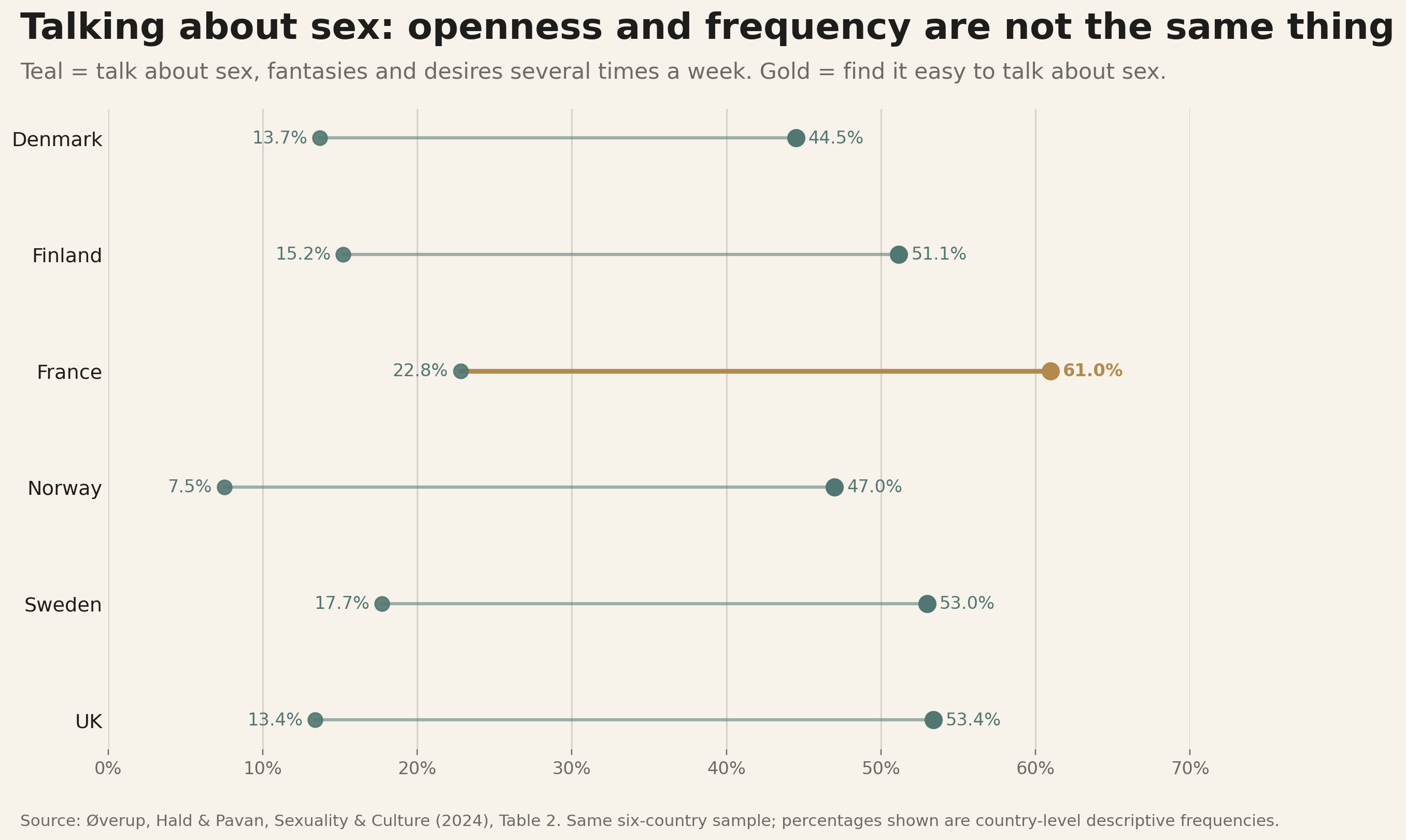
The six-country study on sexual communication produced an intriguing result: French respondents reported greater ease discussing sex, fantasies and desires with partners than respondents in Denmark, Finland, Norway, Sweden and the UK. Around 61% of the French sample described doing so as quite or very easy, compared with roughly 44% to 53% elsewhere. (link.springer.com)
That does not make France “Europe’s least sexually inhibited country”, but it does challenge some easy assumptions.
A society can be progressive on sexual rights and still contain individuals who feel awkward discussing their own desires. Another culture can seem more restrained publicly while allowing different forms of private intimacy.
Sexual openness has several dimensions: what is legal, what is socially acceptable, what appears in popular culture, what people actually do and what they are comfortable admitting.
Those things do not always move together.
Perhaps sex is uncomfortable because it matters so much
There is a temptation to imagine that a truly liberated society would eventually make sex completely ordinary.
Perhaps that is unrealistic.
Sex touches too many sensitive parts of human experience to become entirely neutral. Desire involves validation, rejection, identity, power, intimacy, beauty, ageing, pleasure and vulnerability. It can strengthen relationships and destabilise them. It can be playful and profound, trivial and intensely meaningful.
Perhaps embarrassment is partly the price of significance.
But shame is something different.
There is little reason why adults should feel that wanting sex makes them shallow, that having fantasies makes them strange, that losing desire makes them defective or that discussing sexual satisfaction makes them vulgar.
We have learned to talk about mental health because silence was not helping us. We have learned to talk about relationships because pretending everything was fine did not make relationships better.
Sexuality deserves the same seriousness.
Perhaps the strange thing is not that sex matters so much. It is that something so important is still expected to remain so quiet.
Maybe becoming more comfortable with sex does not mean talking about it constantly. It simply means being able to talk about it when it matters without feeling dirty, ridiculous or ashamed.
And for something humanity has been doing for quite some time, that does not seem like an unreasonable ambition.
How easy is it for you to talk honestly about sex?
Not to joke about it, but to say what you actually want, what you miss, what you enjoy — or what you no longer want at all?
Odeesy explores the conversations we often have in private about love, desire and modern relationships.